Learning Russian, one of the world’s most challenging and richly expressive languages, involves navigating complex grammar, intricate morphology, tricky pronunciations, and a vast cultural context.
Because of this complexity, one of the most common questions for learners is whether it is more effective to study with an online Russian teacher (a professional tutor) or with a peer coach (a peer learner, conversation partner, or fellow student providing guidance).
Both options present valuable benefits, but their effectiveness can differ dramatically depending on the learner’s level, goals, and preferred learning style. Let us offer you a detailed comparison of these two approaches and explain how different learners can get the most out of each method.
First of all, let’s look at some possible pitfalls for foreigners, whose mother tongue is not slavic since Russian is a highly inflected language. It uses:
- Six grammatical cases.
- Complex verb aspects.
- A flexible but rule-driven word order.
- Verbal prefixes that change meaning subtly.
- Pronunciation challenges (reduced vowels, soft consonants).
Because of this structural complexity, the choice of who guides your learning has a major impact on your progress, especially at the beginner and intermediate stages.
Learning Russian with a Professional Tutor

A certified teacher provides lessons built around a clear curriculum. This structured approach is especially valuable for Russian because progression must be intentional, for example, introducing cases in a logical order, carefully selecting vocabulary, and gradually incorporating aspects.
Tutors often use professional textbooks, exercises, self-made worksheets, and communicative techniques that allow learners to build a solid foundation.
Russian grammar concepts such as perfective vs. imperfective, motion verbs (prefixed and non-prefixed), or animacy rules are difficult for learners. A teacher knows:
- how to explain these systematically;
- how to correct mistakes without discouraging the student;
- and how to reinforce correct patterns through practice;
This accuracy reduces fossilized errors: incorrect language habits that become hard to fix later, especially when you speak rapidly and your active vocabulary is vast enough.
Besides, with a professional teacher you set your personalized learning plans, especially when you take one-to-one classes. But that doesn’t mean that in group lessons there can be a lack of teacher’s attention. All of the students reach their mutual goals being guided by the tutor. The learner’s goals could be:
- conversational fluency;
- exam preparation;
- business Russian;
- travelling;
- academic reading;
- or heritage language improvement.
Whereas, a peer coach rarely has the experience to design a full learning trajectory. Moreover, the professional educators know how to: encourage consistency, provide accountability, manage frustration stages, and monitor progress in a healthy, motivating way.
This is crucial with a demanding language like Russian.
Of course, there are some limitations of learning Russian with a tutor. Lessons are pricey, more formal and less spontaneous, speaking time might be more limited compared to casual conversation practice.
Learning Russian with a Peer Coach
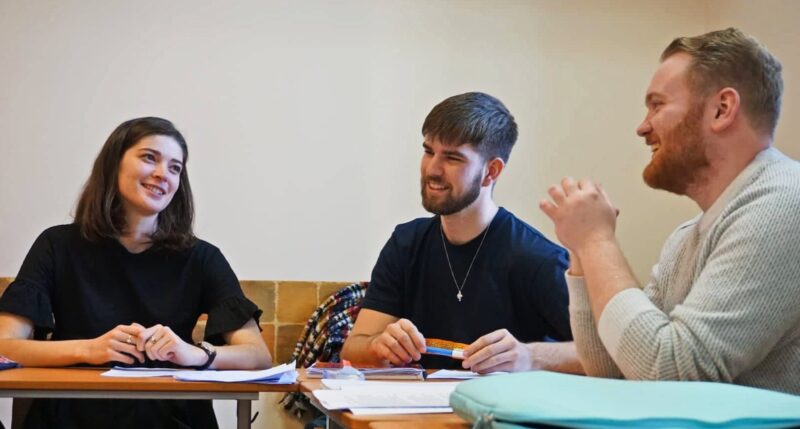
A peer coach is usually a fellow student or native speaker who helps informally, often through conversation, shared materials, or mutual practice.
Peer coaches are excellent for developing:
- spontaneity;
- colloquial vocabulary;
- cultural insights;
- everyday expressions (sometimes curse words) that may not appear in textbooks.
They can expose you to speech patterns typical of native speakers in relaxed settings, which for some learners seems to be an essential aspect of language learning. Because peer coaching is informal, learners often speak much more, improving fluency, confidence, automaticity, and listening comprehension.
For Russian, immersion and repeated conversational exposure are especially helpful. Learners often feel less anxiety with peers. This comfort promotes experimentation and creativity with the language both essential for internalizing Russian grammar. And peer coaching is usually inexpensive or free, making it highly accessible.
Limitations of Peer Coaching:

- Unreliable explanations of grammar or language mechanics.
- Lack of structure, which can lead to slow or uneven progress.
- Potential reinforcement of errors if the peer coach is not well-trained.
- Inconsistency, depending on the partner’s schedule and commitment.
- Peer coaching alone is usually not sufficient for mastering Russian from the beginner level.
As a conclusion, it’s important to say that both professional tutors and peer coaches play important but distinct roles in learning Russian. A certified teacher is essential for building a strong linguistic foundation, especially in the early stages. A peer coach, meanwhile, accelerates real-life communication skills, boosts confidence, and provides immersive practice.
The most effective approach is not choosing one over the other, but understanding when to use each. Beginners benefit most from structured tutoring, while intermediate and advanced learners progress fastest through a combination of tutoring and peer interaction.
Ultimately, the ideal path depends on your goals, your motivation style, and the type of Russian you hope to speak academic, conversational, professional, or fluent native-like speech.